
Clagstone Country EstatesContact

Connectivity · Network design · The trunk

The trunk,
by the numbers.

Road and lot figures here come off the civil drawings. The trunk itself does not: there is no communications conduit anywhere in the approved set, so the route and its lengths are CIS's own plan, traced along the street alignments. This is the sheet for readers who want to know what goes in the ground, and which parts are still a plan.

Mainline ring
~2 mi
Trunk cable per phase
72 fiber
Tap vaults on the ring
58
Fiber type
Single-mode

The route

It follows the roads, because the roads were the plan.

The trunk rides the road corridor for its full run: out of the core, around the interior loop, past every lot frontage, and home again on the far side. Traced along the street alignments it comes to about two miles of mainline. Phase 1's two streets open a bit over half of that frontage, which is why Phase 2 finishes the loop rather than starting one. Those are round numbers on purpose: the street geometry we can measure today is approximate, and the trunk is a planned route rather than a surveyed alignment.

The two legs of the ring return to the core in separate trenches on opposite sides of the road. That is the detail that turns a loop of glass into an actual ring: one dig strike anywhere leaves every vault reachable from the other direction while the splice crew works.

Project: CIS fiberSubject: the ringSheet: 1 of 3By: the neighborhood
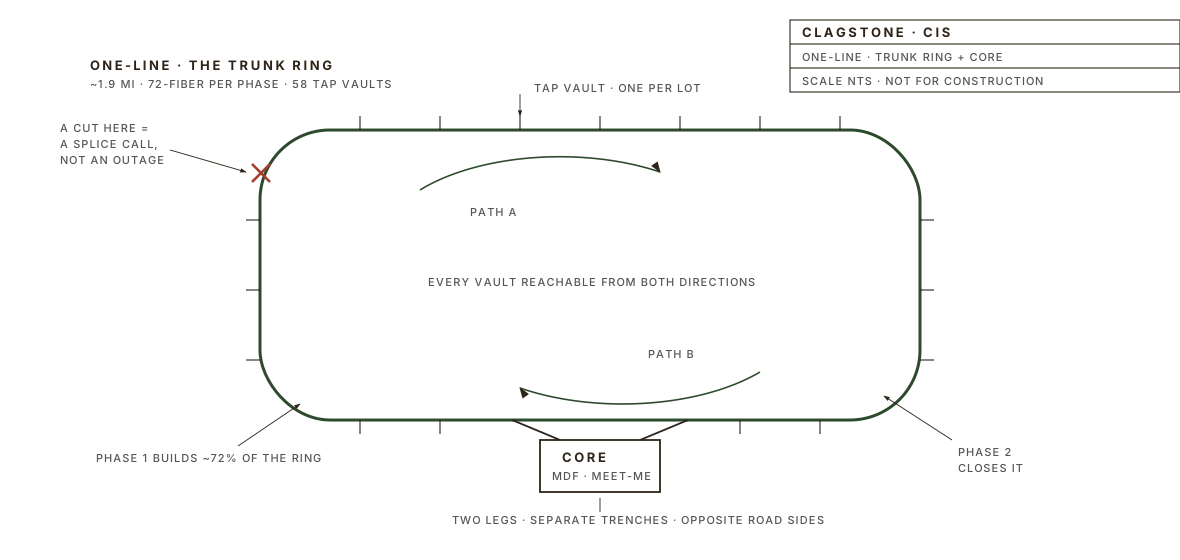
One-line diagram of the trunk ring: a loop passing 58 tap vaults, two legs returning to the core in separate trenches, path A and path B arrows showing every vault reachable from both directions, and a marked cut labeled a splice call, not an outage
The whole network, one line

Phase by phase

Each phase pulls its own glass.

A 72-fiber single-mode trunk goes in with each phase's civil work, while that phase's trench is open. Dedicated pairs come off the phase trunk to that phase's homesites; what is left rests in the vaults as spares.

PhaseHomesitesWorking strandsNew mainlineTrunk cable
Phase 12550 of 72~1.2 mi72-fiber single-mode
Phase 23366 of 72~0.55 mi, closes the ring72-fiber single-mode

Phasing the glass with the land keeps the plant honest: no strand is bought for a road that does not exist yet, and no homesite waits on a phase it is not part of.

In the trench

Built to be found, spliced, and grown.

  • Conduit with innerduct. The trunk pipe carries innerduct so future cable is blown in without opening ground. The dig happens once.
  • It has its own room. The approved road sections carry a perpetual ten-foot roadway, drainage and utility easement along each side of the sixty-foot right of way. That easement is where the trunk lives, outside the pavement and outside your lot, which is why a future pull never needs anyone's permission or anyone's driveway.
  • A tap vault at every frontage. Each of the 58 homesites gets a service vault on the ring with slack loops coiled and waiting, sized for a future second service, not just the first one.
  • Locatable for decades. Tracer wire in the trench, and every run, vault, and splice point mapped in the same records as the plat. The crew that finds this plant in thirty years will know exactly what they are looking at.
  • The handoff stays clean. The trunk ends at your vault. Your lateral, your timing, your trench, and CIS pulls the glass and owns the termination once your pathway is in. The full model is on the design page.

The ring passes your frontage.

Come walk the corridor and see where your vault taps in.